
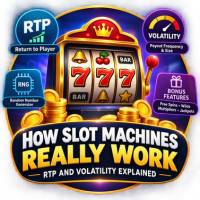
Slot Machines may look simple choose a bet, spin the reels, and wait for the result—but modern slots use software and mathematical systems behind every spin. Understanding RTP (Return to Player) and volatility can help players understand how a slot is designed, how payouts are distributed, and why winning patterns can vary considerably.
What Is a Slot Machine?
A slot machine is a game that generates outcomes using a Random Number Generator (RNG). When you press the spin button, the software selects a result from a large range of possible outcomes. The reels then display symbols that correspond to that result.
The important point is that previous spins normally do not determine the next spin. A machine that has not paid a win for several spins is not automatically “due” for a payout.
How the RNG Works
The RNG continuously produces numerical values, even when nobody is playing. When a spin is initiated, the game uses a value generated at that moment to determine the outcome.
The selected result determines factors such as:
- Which symbols appear on the reels
- Whether a winning combination is created
- The size of the payout
- Whether a bonus feature is triggered
- Whether a free-spin feature appears
This process is designed to make individual results unpredictable.
What Does RTP Mean?
RTP stands for Return to Player. It is a theoretical percentage that describes how much of the money wagered on a slot is expected to be returned to players over a very large number of spins.
For example, imagine a slot with a theoretical RTP of 96%. Over an extremely large number of wagers, the mathematical model is designed to return approximately $96 for every $100 wagered, while the remaining amount represents the game’s theoretical house edge.
This does not mean a player will receive exactly 96% of their money back during a personal session.
RTP Is a Long-Term Figure
RTP should be viewed as a statistical measurement rather than a promise.
A player could:
- Win significantly more than their total stake
- Lose most or all of their bankroll
- Experience a long sequence without a major payout
- Hit a large bonus early in a session
Short-term results can differ dramatically from the theoretical RTP because random outcomes naturally create variation.
What Is Slot Volatility?
Volatility, sometimes called variance, describes how frequently a slot tends to pay and how large its potential payouts can be.
It is commonly discussed in three broad categories:
Low Volatility
Low-volatility slots generally aim for smaller and more frequent payouts. They may suit players who prefer a steadier pattern of results, although losses are still possible.
Medium Volatility
Medium-volatility games sit between the two extremes. They may offer a mixture of smaller wins and occasional larger payouts.
High Volatility
High-volatility slots can have longer periods without significant wins, while certain winning combinations or bonus features may produce much larger payouts.
High volatility does not mean a player is more likely to make a profit. It mainly describes the distribution and size of potential results.
RTP vs Volatility
RTP and volatility describe different aspects of a slot.
| Factor | What It Tells You |
|---|---|
| RTP | The game’s theoretical long-term return |
| Volatility | How payouts may be distributed |
| RNG | How individual outcomes are generated |
| Hit Frequency | How often winning combinations may occur |
| Maximum Win | The game’s advertised upper payout limit, where applicable |
A slot can have a relatively high RTP and still have high volatility. Therefore, looking at RTP alone does not tell you what your short-term experience will be like.
Why You Can Lose Despite a High RTP
Suppose a game has a 96% theoretical RTP. That does not mean every player receives 96% of their wagers back.
RTP is calculated across a very large number of game outcomes. Your own results may be dramatically different because of randomness.
For example, one player could experience several profitable spins while another player experiences a losing session during the same game. Neither outcome necessarily indicates that the slot’s RTP has changed.
Do Slots Have “Hot” and “Cold” Streaks?
Players sometimes describe slots as “hot” when they appear to produce frequent wins and “cold” when they seem to produce fewer wins.
However, previous outcomes generally do not make a future spin more likely to win. A sequence of losing spins does not automatically mean that the next spin has better odds.
This is one reason it is important not to chase losses based on the belief that a payout is “due.”
What Is Hit Frequency?
Hit frequency refers to how often a game produces a winning result according to its mathematical design.
A slot with a higher hit frequency may produce more winning combinations, but those wins can be relatively small. Another game may produce fewer winning results while offering the possibility of larger payouts.
Therefore, more frequent wins do not necessarily mean greater overall profitability.
Understanding Maximum Win
Some modern slots advertise a maximum win expressed as a multiple of the stake, such as 1,000x or 10,000x.
A maximum-win figure represents the upper limit specified by the game’s mathematical design. It does not mean that a player is likely to achieve that result.
Before playing, check the game’s official rules or paytable to understand how the maximum payout and bonus features work.
How Bonus Features Affect Results
Many slots include features such as:
- Free spins
- Multipliers
- Wild symbols
- Scatter symbols
- Bonus rounds
- Progressive jackpots
- Buy-feature options
These features can significantly affect the distribution of payouts. The game’s published information may explain the conditions required to trigger them.
What Should You Check Before Playing?
Before choosing a slot, look at the game’s information panel or official rules and check:
- RTP percentage
- Volatility level, if disclosed
- Paytable
- Minimum and maximum bet
- Maximum potential payout
- Bonus-feature rules
- Jackpot conditions
- Wagering or bonus restrictions
- Whether the game is available through a properly authorized operator
- The laws and regulations applicable where you live
RTP Does Not Predict Your Next Spin
One of the most important concepts to understand is that RTP is not a prediction tool for individual spins.
If a slot has a 96% RTP, you cannot calculate that your next 10 spins should return approximately 96% of your stake. Random variation can produce very different results over a small number of spins.
RTP becomes meaningful as a statistical property over a very large sample of game outcomes.
Play With a Fixed Budget
Understanding mathematics does not remove the financial risk involved in slot play. If you choose to play, set a spending limit before starting and avoid increasing your stake simply because you are losing.
Never treat RTP as a guarantee of profit, and do not use gambling as a way to recover money you have already lost.
Conclusion
Slot machines rely on mathematical models and RNG technology to determine game outcomes. RTP explains the theoretical long-term return of a game, while volatility describes the pattern and size of its potential payouts. Neither measurement can predict the result of your next spin.
Knowing the difference between RTP, volatility, hit frequency, and maximum win can make slot information easier to understand and can help you approach gambling with realistic expectations
FAQs
What does RTP mean in slot machines?
RTP means Return to Player. It is the theoretical percentage of wagers a slot is designed to return to players over a very large number of spins. It is not a guarantee of what an individual player will receive.
Does higher RTP mean more frequent wins?
Not necessarily. RTP measures theoretical long-term return, while volatility describes how wins are distributed. A slot can have a relatively high RTP but still have high volatility and potentially long periods between significant wins.